Project Euler Geocaching Cambridge
A couple of years ago I used the Project:Euler challenges as a stimulus/introduction toPython. They were good at teaching the basics, but the motivation camr from solving quite geeky maths challenges. I discovered last summer that these had been used as the basis for a series of “mystery” Geocaches around Cambridge, UK.
The cool idea is that these special GeoCaches require you to write pretty much the same code as for the Euler Challenges, apply the code to some specific values which return a number which is then used to generate co-ordinates (a checker is included on the site to avoid wild goose chases). When I set these as homework, the submission was just asking for a photo of the student with the GeoCache!
Let’s take a look at the first Project:Euler challenge.
Multiples of 3 and 5 - Problem 1
If we list all the natural numbers below 10 that are multiples of 3 or 5, we get 3, 5, 6 and 9.
The sum of these multiples is 23.
Find the sum of all the multiples of 3 or 5 below 1000.
We might approach the problem using Swift code as follows (using a Playground in XCode):
var sum=0

for n in 1...1000{
    if n%3==0{sum = sum+n}
    else if n%5==0{sum = sum+n}
}

print(sum)

#=> prints '234168' to STDOUT.
The first Project:Euler inspired Geocahe introduced as follows:
If we list all the natural numbers below 10 that are divisible by 3 or 5, we get 3, 5, 6 and 9. The sum of these multiples is 23.
Define f(n) as the sum of the multiples of 3 and 5 which are less than n. Thus we can write:
f(10) = 23.
Then N = f(4720) + f(240) + f(77),
and E = f(175) + f(10).
func f(n:Int) -> Int {
    let m = n-1
    var sum=0
    for n in 1...m{
        if n%3==0{sum = sum+n}
        else if n%5==0{sum = sum+n}
    }
    return sum
}

let N = f(4720) + f(240) + f(77)

let E = f(175) + f(10)

print("N =", N)
print("E =", E)

#=> prints 'N = 5212178, E = 7141' to STDOUT.
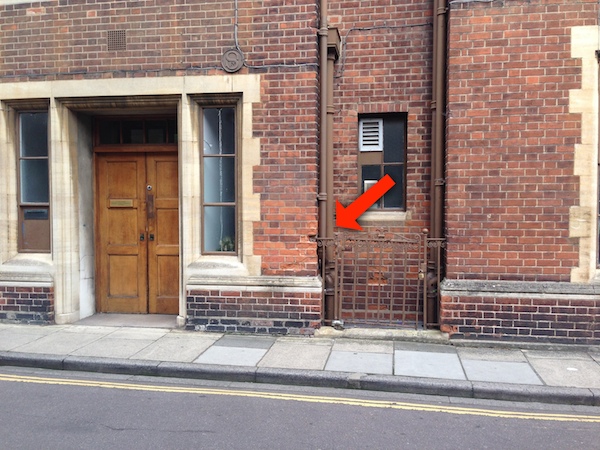
This translates as the the co-ordinates N 52°12.178 and E 00°07.141. Which we can enter into the Geochecker for confirmation and discover a location near my PhD advisor’s rooms in Corpus!